

Internal referrals often bypass the rigorous evaluation applied to external senior hires — and that’s where we see many costly mistakes.
Referrals arrive pre-vetted, understand your company culture, and, in theory, should reach full productivity faster than cold hires. But relaxing hiring standards for them, even unintentionally, creates risk for private equity senior leadership that compounds over time.
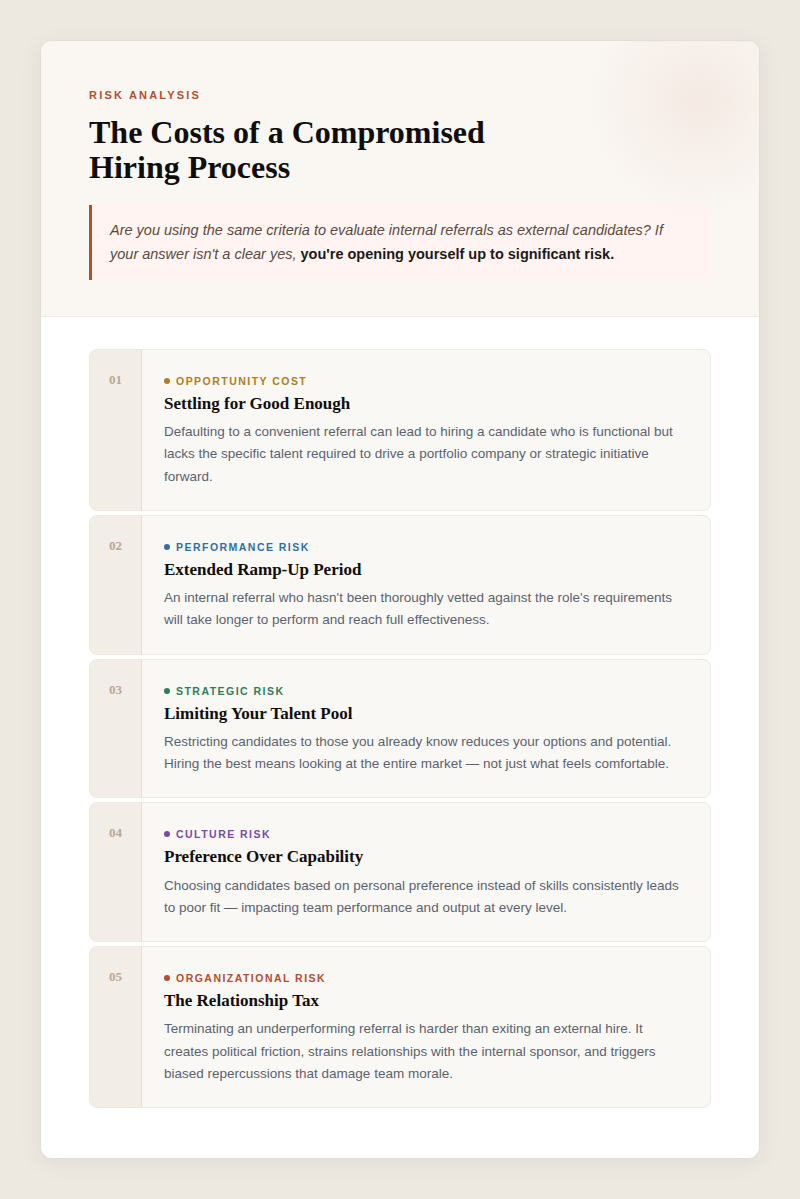
The Costs of a Compromised Hiring Process
1- The Opportunity Cost of Good Enough
The biggest risk of internal referrals is the halo effect: decision-makers favor a recommender’s reputation over objective qualifications, subtly lowering the bar without realizing it. The highest cost is missing the best hire entirely. At the senior leadership level, the distinction between competent and exceptional is where value is created or lost.
2- Extended Ramp-Up Period
An internal referral who hasn’t been thoroughly evaluated against the role’s requirements will face a steeper learning curve. Without an objective vetting process, you miss out on one of the main advantages of a referral: quicker time-to-productivity. Instead, you end up dealing with a longer onboarding period and the hidden costs that come with slower adjustment to the job.
3- Limiting Your Talent Pool
By prioritizing internal networks over the broader market, you unintentionally shrink your talent pool. Relying on what feels comfortable limits your options and prevents you from discovering high-caliber talent outside your immediate circle, which may be significantly stronger than anyone in your referral network.
4- The Hidden Cost to High Performers
Strong employees notice when someone isn’t carrying their weight — especially when that person was hired for culture fit over capability. Weak hires don’t just affect the role; they erode the retention of the people you most want to keep.
5- The Relationship Tax
Terminating an underperforming referral is far more complex than offboarding an external hire. It introduces political friction, strains the relationship with the internal sponsor, and can damage team morale if the person is perceived as protected by their internal connections. The costs are not only operational; they affect the organization as a whole.
How to Hire Internal Referrals the Right Way
To reduce the hidden risks of internal referrals, your hiring process should treat all candidates equally, regardless of their source. Applying the same high standards to internal referrals and external candidates ensures that every hire is the best available instead of just the most convenient.
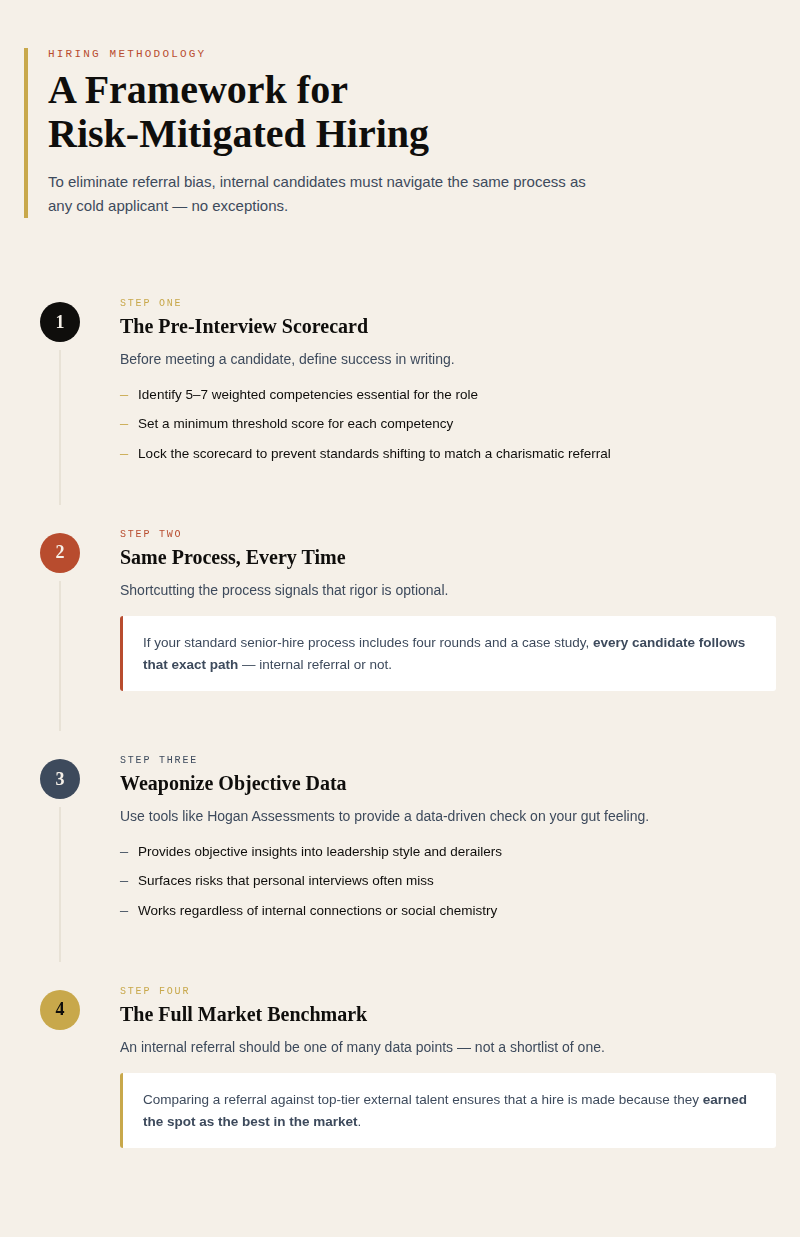
A Framework for Minimizing Risks in Hiring Internal Candidates
Step 1: The Pre-Interview Scorecard
Before you speak to a single candidate, whether internal or external, you must define exactly what success looks like in writing.
- Identify 5–7 weighted competencies essential for the role
- Set a minimum threshold score for each
- Secure the scorecard with all stakeholders before any interviewing begins
Locking these criteria in advance removes the single greatest source of referral bias: the tendency to rewrite the role around the person rather than evaluate the person against the role.
Step 2: Same Hiring Process, Every Time
Shortcutting the process for an internal referral signals to the rest of your firm that hiring rigor is optional (and that signal travels fast). If your standard senior-hire process includes four rounds and a case study, every candidate must follow that exact path. Skipping these steps creates risk with this hire and also sets a precedent for the next one.
Step 3: Leverage Objective Data
Structured evaluations like Hogan Assessments provide valuable data points that help you see beyond the halo effect of a strong referral. Familiarity with a candidate makes it easy to fill in the blanks with assumptions. Evidence-based interviews force you to replace those assumptions with data.
Step 4: The Full Market Benchmark
An internal referral should be one of many data points. Before extending an offer, run a parallel external search. If the referral is genuinely the strongest candidate, a market benchmark confirms it and gives you confidence in the hire. If they’re not, you’ve just avoided a costly mistake that would have been invisible without the comparison.
Don’t Lower the Bar for Internal Referrals
Internal referrals are valuable, but only when held to the same standard as every other hire.
We partner with private equity firms and high-growth organizations to build structured hiring processes that raise the bar and ensure every senior hire is the best available candidate in the market — not just the most convenient one. If you’re ready to close the gap between your current process and the rigor your business actually requires, let’s talk.